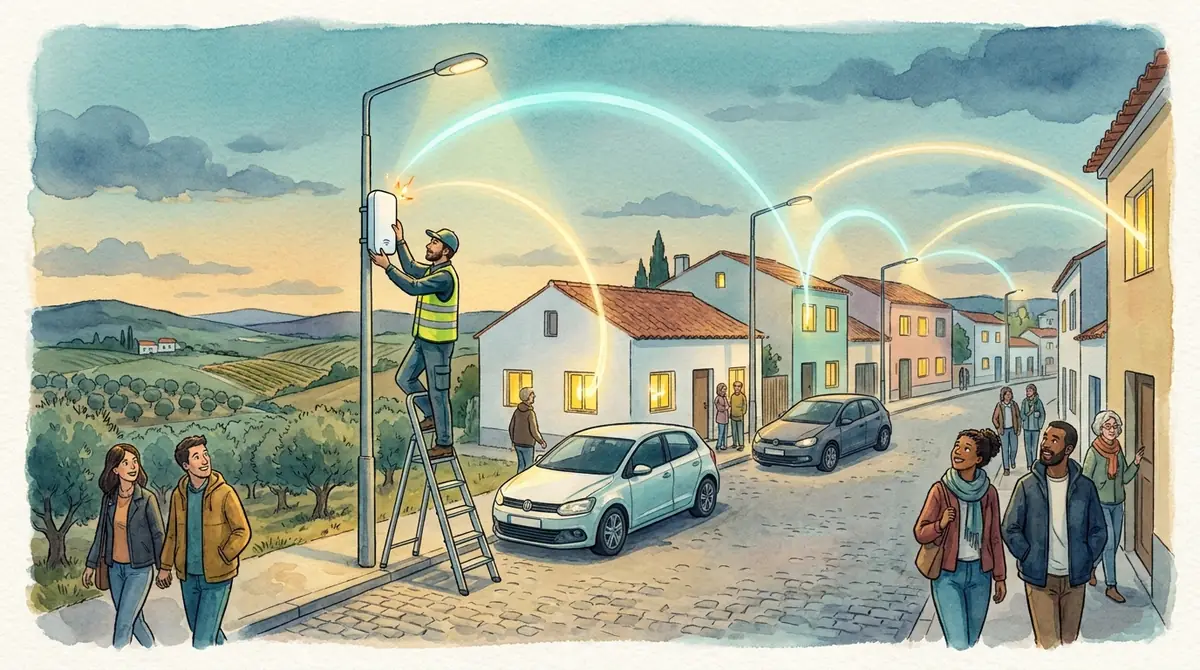
WiFi for your village from €2500
Ready-to-flash OpenWrt firmware + EU right of access to public streetlamps. 15 nodes cover 1-2 km². Hosts get a full-speed pass across the whole network.
Download firmware
Ready-to-flash OpenWrt firmware + EU right of access to public streetlamps. 15 nodes cover 1-2 km². Hosts get a full-speed pass across the whole network.
Download firmware850,000 Portuguese without decent internet — telcos don't invest in the «white spots» of the map
Streetlamps and electricity poles are everywhere, but local councils don't know they have an EU right to use them
Commercial solutions cost €15-30k per village — out of reach for any small council
OpenWrt 25.x with zero-touch first-boot configuration. 7 supported routers, two profiles (Bumblebee gateway + Bee relay). Plug in and forget.
Nodes auto-discover each other. Seamless 802.11r/k/v WiFi roaming (~50ms handoffs). Nightly OTA updates with SHA256 verification.
Guest traffic exits through a WireGuard tunnel via Mullvad. You're not liable for visitor activity (EU Mere Conduit). Automatic kill switch.
512 kbps free for everyone. Whoever wants full speed pays 5,000 sats for 30 days, received by the association and spent on the network. Keep a node running and your own pass costs nothing.
EU Regulation 2024/1309 (Gigabit Infrastructure Act) forces E-REDES and municipalities to grant access. In force since 12.11.2025. Request template ready.
See active nodes on the Parahub map in real time. Every new router shows up automatically after first boot. No signup, no approval.
Start with municipal lampposts — the council decides on its own, and a free network in general needs no operator registration. For E-REDES poles or paid traffic: file the prior notification with ANACOM — that is what makes you an operator with a legal right of access to the poles
Buy 3 Cudy AP3000 Outdoor (~€270) for the pilot — your electrician wires them «before the relay» on the lamppost
Plug in the PoE cable — the router auto-configures, appears in /iot and on the coverage map
MIT licensed, no fees. Hosts get full speed, the network belongs to the community. Civic infrastructure shouldn't cost money.
Download firmware